Whoa, hurricanes. Americans don’t think too much about hurricanes, unless we life around the Gulf of Mexico. For the rest of us, it is a bunch of funny sounding named (Olga? Wilma?) swirling colors far out in the ocean. Last year, the DR got pounded first by Noel in October, when it rained for seven straight days, and then by Olga in December, when a dam broke, resulting in numerous deaths and extensive property damage. Recently, we have taken hits from four storms in a row: Fay, Gustav, Hannah, and Ike. We were pretty lucky here, though our neighbors Haiti, Cuba, and the Bahamas didn’t catch a break.
Anyway, back to me. Back in August, when I was in the States, Fay moved past the DR. Then, the morning I got here, Peace Corps notified us about Gustav. We were put under “standfast,” which means that we are not allowed to leave whatever our current location is. The storm moved to our south, and did some pretty significant damage down there. Since I live up in the north, all we received was a little rain.
The next weekend, I went to Celebrando el Cibao, which I wrote about earlier, and then went to the capital on Monday for a meeting. As I was about to leave on Wednesday, we were informed that Hannah was coming, and so we were put under “standfast” again. Standfast in the capital isn’t that bad – we receive per diem, and get luxuries like the internet and AC that don’t happen too often (ie ever) where we live. Hannah was a little difficult – for a few days, instead of moving west it turned south and almost hit Haiti, before moving back north and west again. During Hannah, we watched Ike form – a massive Category 4 storm churning out in the Atlantic. Peace Corps was in crisis mode. At the end of Hannah, we were allowed to leave the capital, but the next day for Ike the Volunteers in my region were “consolidated.” This means that we all get together at a central, secure location. This location turned out to be a really nice hotel with a pool, tennis and basketball courts, a casino, great food, and most importantly, really sturdy walls. We were left there for four days. Things like these pose problems for us. We all have our work at home – youth meetings, building projects, English classes – that we obviously can’t attend to while we are at the hotel. We worry about our communities, and have trouble getting in touch. Sure, consolidation is great, but we have our lives we have to take care of outside of fun hotel jaunts. Our neighbors cannot figure out why we leave. If our neighbors stay, why don’t we? This is the hardest question to answer. We have to, we say. But we also are Americans, cared for by our government, and we can afford it. That’s just not they way it is for our neighbors.
When I got back, my neighbor had made a dessert called “toto de monja.” Ten points for someone who knows what this means, and then they get some.
martes, 23 de septiembre de 2008


 Four days after I returned to the DR, I participated in a weekend conference of volunteers from the northern valley region of the country, called the Cibao. (Thank you to those who supported this conference from the States. All of us here are very appreciative.) The conference, focusing on diversity and aptly named Celebrando Cibao, brought together two youth from each volunteer’s community (there were about 25 of us) for three days of speakers, discussions, and interactive programs. You can imagine that when I first heard about the Celebrando conference, I was pretty pumped, as I dedicated a fair amount of time at college to such activities. This is the Peace Corps’ version of YLEAD. It didn’t turn out quite the same, but it was similar in spirit, which is the important part. Sure, there were some slip-ups and last-minute cancellations, but we got the message across, more or less.
jueves, 18 de septiembre de 2008
Los EEUU

America!
I went home for a couple weeks last month. Yeah, America was still there. I guess I had forgotten some of the things I like about it. Sure, its fun here. But flat-screen hi-def plasma TVs are fun too. So much detail. I went back to the grocery store and stood there, mouth open. There was so much stuff. Thousands of kinds of cheese. I wonder sometimes if it is all necessary. But then I see real Heinz ketchup, not the low-quality overly sweet stuff they call “catsoo.” I think the food is what really got me. There is so much good stuff here. Mexican, Thai, Chinese, its all amazing. Also, bagels. Bagels and lox. Nothing better. The visit went by too quickly, but I was able to get in a visit to Boston for my cousin’s wedding (mazel tov!), be around to celebrate my grandmother’s 80th birthday, and run around Washington, DC for a few days to finally see my name on the wall at the Tombs.
I had heard from other volunteers that coming back to a volunteer’s life was a difficult adjustment. After being in the States, with all of life’s luxuries, and even those simple things (electricity all the time?), it is hard to get back into things. At this one-year mark, which a few of us celebrated by going the beach and then me subsequently getting a double ear infection, we have to reassess what it is exactly that we are doing here. Are we accomplishing our goals, personally or work-related? Are we really that integrated in our communities? What are we actually doing here? Let’s not get started on sustainability. Right now we are just trying to accomplish something for ourselves, let alone the progress reports we are required to send in to prove that Peace Corps still deserves to receive federal funding. It does, of course, but not because we are saving the world. The stove we build that uses less wood, thus helping the environment, and has a chimney, so women don’t have to breathe in smoke five hours a day, is just as or more useful than a business presentation that will go right over the heads of its participants.
I got back to my site, then, expecting the worst, hoping for the best, and landing somewhere in the middle. Really, I guess, the best happened. It took me about a day, but I got right back into my routine. I remembered how much I appreciate what I do and what my community means to me. It definitely helped that my neighbors were thrilled to see me again and I got some free food as a welcome back gift. They know already the way to my heart. Hopefully a good omen for the rest of my service.
This is a beach relatively close to me (read: on the same island as I am)
martes, 12 de agosto de 2008
The daily trials of a Volunteer
The Peace Corps here in the DR publishes a magazine three times a year, called the Gringo Grita ("grita" means something like scream or yell). In the last edition, which had a man-eating mango on the cover and featured pieces about relations between Haiti and the DR and among Peace Corps Volunteers and locals, I wrote a very personal piece about some medical difficulties and how I overcame them. Enjoy.
“Squish, squish,” said my stormy abdomen, churning gloriously. I winced.
“Crunch, whoosh,” it retorted. I winced again, and made a sad face.
“Squirt.” Oops.
That day’s conversation with my roiling innards was not any different than any other day for the three months following Thanksgiving. Through the smashing waves of New Years and project partner presentations of IST, I had been in constant state of disagreement with my digestive system. Perhaps, rather, it was in disagreement with me. Whatever the case, we were not on good terms. This problemita I had just would not go away. I was put on PCDR Medical cure-all, Gabbroral, twice, but to no avail. I consigned myself to twenty-seven months of internecine turmoil.
I realized it didn’t have to be like that. I could live an ordinary life, eating all the platano sancocha’o I could ever want. One quick call to Lisette gave me the key to potential normalcy. The Stool Sample. This was no small step. It had been offered to me before, but I was hesitant. Do my business in a cup? No thanks. I had heard from those who have had the pleasure that it was uncomfortable. I came to realize, however, that the ends justified the means. I would go through with the unpleasantries of The Stool Sample, as they were less of those than living with an internal Mount Vesuvius.
So, after I listened to my heart, I took the Caribe Tours – Arctic Express bus down to the capital for the poop procedure.
“Here you go,” Boriana said cheerily, handing over what looked to me like a cheap coffee cup in a wax-paper bag. “They don’t need that much, but try to get different bits in there for more complete test results. Also, the van to the clinic leaves the office at 7:30. If you miss that, you’ll have to take it there yourself.”
The luxe digs of Volunteers in Santo Domingo aren’t exactly the most comfortable for those with medical issues, which is probably why those poor kids get the one nice room, the Dengue Suite. Nevertheless, it being the capital, evening activities took their toll. I woke up well after the early morning pick-up. I would have to bring the sample to Clinica Abreu myself.
I walked out of room 14 and steeled myself. Wandering down the hall, I sipped a miniature plastic cup of water from the cooler, watched a bit of the mid-morning telenovela and the returned to the room. I was ready.
I removed the paper coffee cup from its protective bag and slipped into the bathroom, feeling at once terrified and strangely pleased. I positioned myself in a sort of half-lean over the toilet, and awkwardly placed the cup underneath me. I tried to heed the good words of Boriana, but it wasn’t that easy. It never is. The cup was situated slightly incorrectly – I missed and might have got my hand. Within seconds and way too soon, the cup overflowed. Splatter ensued. But I had done it. I was triumphant.
My euphoria fell, after thorough hand washing, when I realized I now had to traverse downtown Santo Domingo with a cup of my own poop in my hand. I needed help, and enlisted a fellow Volunteer to take this journey with me. By the time we had crossed Bolivar, she was walking ten feet behind me. I asked her why she was so far away. The smell, she told me. I guess I had not noticed it, or not wanted to. The wax-paper bag was not a terribly good protective barrier for the outside world from my malodorous offerings. Being of good heart, my travel companion stayed with me, even as I offended the general population with my wax-paper bag (Thanks, Joanna!).
We finally reached the clinic. I took a number, sat down, and put the treasure bag under my chair. According to the number display, I knew I was going to have to wait awhile. After settling in, I realized that of all the empty seats in the nearly full waiting room, the majority was right next to me. New patients seemed to strategically place themselves as far away from me as possible, putting on sour faces and suppressing giggles. My audibly gurgling intestines probably gave me away as the source of their olfactory discomfort, overcoming even my coy smile.
My number was finally called and the clerk beckoned me into the analysis room. I had heard that the sadistic nurses make patients scoop their own poop into the machines, but thankfully these nurses had eaten their viveres that morning and were fairly cheery. I did, however, get a killer look from the nurse who had the misfortune of opening my special container. I grinned. The pleasure was all mine.
I arrived back at site the next day. The call from the medical office reported that my test results had come back negative. As much as I thought I had very close special friends living with me, the tests found no amoeba, parasite or giardia. By then, however, it didn’t matter. I was feeling better already. I had pooped in a cup, and I was cured.
“Squish, squish,” said my stormy abdomen, churning gloriously. I winced.
“Crunch, whoosh,” it retorted. I winced again, and made a sad face.
“Squirt.” Oops.
That day’s conversation with my roiling innards was not any different than any other day for the three months following Thanksgiving. Through the smashing waves of New Years and project partner presentations of IST, I had been in constant state of disagreement with my digestive system. Perhaps, rather, it was in disagreement with me. Whatever the case, we were not on good terms. This problemita I had just would not go away. I was put on PCDR Medical cure-all, Gabbroral, twice, but to no avail. I consigned myself to twenty-seven months of internecine turmoil.
I realized it didn’t have to be like that. I could live an ordinary life, eating all the platano sancocha’o I could ever want. One quick call to Lisette gave me the key to potential normalcy. The Stool Sample. This was no small step. It had been offered to me before, but I was hesitant. Do my business in a cup? No thanks. I had heard from those who have had the pleasure that it was uncomfortable. I came to realize, however, that the ends justified the means. I would go through with the unpleasantries of The Stool Sample, as they were less of those than living with an internal Mount Vesuvius.
So, after I listened to my heart, I took the Caribe Tours – Arctic Express bus down to the capital for the poop procedure.
“Here you go,” Boriana said cheerily, handing over what looked to me like a cheap coffee cup in a wax-paper bag. “They don’t need that much, but try to get different bits in there for more complete test results. Also, the van to the clinic leaves the office at 7:30. If you miss that, you’ll have to take it there yourself.”
The luxe digs of Volunteers in Santo Domingo aren’t exactly the most comfortable for those with medical issues, which is probably why those poor kids get the one nice room, the Dengue Suite. Nevertheless, it being the capital, evening activities took their toll. I woke up well after the early morning pick-up. I would have to bring the sample to Clinica Abreu myself.
I walked out of room 14 and steeled myself. Wandering down the hall, I sipped a miniature plastic cup of water from the cooler, watched a bit of the mid-morning telenovela and the returned to the room. I was ready.
I removed the paper coffee cup from its protective bag and slipped into the bathroom, feeling at once terrified and strangely pleased. I positioned myself in a sort of half-lean over the toilet, and awkwardly placed the cup underneath me. I tried to heed the good words of Boriana, but it wasn’t that easy. It never is. The cup was situated slightly incorrectly – I missed and might have got my hand. Within seconds and way too soon, the cup overflowed. Splatter ensued. But I had done it. I was triumphant.
My euphoria fell, after thorough hand washing, when I realized I now had to traverse downtown Santo Domingo with a cup of my own poop in my hand. I needed help, and enlisted a fellow Volunteer to take this journey with me. By the time we had crossed Bolivar, she was walking ten feet behind me. I asked her why she was so far away. The smell, she told me. I guess I had not noticed it, or not wanted to. The wax-paper bag was not a terribly good protective barrier for the outside world from my malodorous offerings. Being of good heart, my travel companion stayed with me, even as I offended the general population with my wax-paper bag (Thanks, Joanna!).
We finally reached the clinic. I took a number, sat down, and put the treasure bag under my chair. According to the number display, I knew I was going to have to wait awhile. After settling in, I realized that of all the empty seats in the nearly full waiting room, the majority was right next to me. New patients seemed to strategically place themselves as far away from me as possible, putting on sour faces and suppressing giggles. My audibly gurgling intestines probably gave me away as the source of their olfactory discomfort, overcoming even my coy smile.
My number was finally called and the clerk beckoned me into the analysis room. I had heard that the sadistic nurses make patients scoop their own poop into the machines, but thankfully these nurses had eaten their viveres that morning and were fairly cheery. I did, however, get a killer look from the nurse who had the misfortune of opening my special container. I grinned. The pleasure was all mine.
I arrived back at site the next day. The call from the medical office reported that my test results had come back negative. As much as I thought I had very close special friends living with me, the tests found no amoeba, parasite or giardia. By then, however, it didn’t matter. I was feeling better already. I had pooped in a cup, and I was cured.
miércoles, 30 de julio de 2008

martes, 22 de julio de 2008
July 4 and new house


July 4 in the DR. Peace Corps Volunteers. How do you envision this? I am curious to find out how things like this go in other countries. For us, we had a beach party. Fully half of the volunteers here took a bus 8 hours from the capital to the border with Haiti to a deserted beach in a national park called Bahia de las Aguilas (Eagle Bay). For the first time in known history, the park did not let volunteers spend the night at the beach. This is because it is turtle nesting season. You might say, well, don’t turtles nest at the same time every year? The answer is yes, but the park only decided to enforce its rules this year, possibly because of capacity building due to a volunteer being placed at the park. Still a good time, and absolutely beautiful.
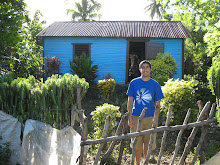
I have finally moved into my new house. Specs: Tin roof, wooden walls, two bedrooms, living room, kitchen, no running water, latrine, two light bulbs, four windows (window means angled wooden slats), rickety gazebo, baths taken outside or at neighbor’s. I repainted the whole thing except the kitchen (which is white) bright blue, and the windows brown. I live with dozens of lizards, the occasional tarantula or cockroach, any number of spiders, and hundreds of mosquitoes. No rats. Visitors welcome.

When I was in Spain, people my age called each other “tío” and sometimes “tía.” Literally, uncle and aunt, this roughly translated as “dude.” Tío doesn’t fly here. Like “vale,” (meaning OK), it just confuses them, and I dropped the habit. But what to call my friends besides their names? This has been my quest since I got here, among others. I think that I have picked up on something, the terms “tipo” and “sujeto” and their feminine counterparts. Literally type and subject, they seem to roughly correlate to “guy/gal” and “dude/man.” “Tipo” is never used to call someone, just to refer to them. For example: “Este tipo estaba dando la muela a mi mujer, entonces le dí una galleta.” More or less meaning “This guy was hitting on my girl, so I hit him.” To call one another, people say “sujeto,” as in “Que lo que sujeto,” roughly “Whats up, dude.” All this is based on the four Dominican males my age who I hang out with; everyone else is over 40 with kids or 13. So they could have made all of this up.
Speaking of word choice, I’ve always been interested in place names. At home, they are all named after dead Indians or something nauseatingly bucolic. At least they sounded nice. Here, at least in my area, they tend to be much more literal. Many villages are nature-themed. My village and the neighboring one are both named after endemic trees, and there are other, more familiar fruit and tree names: Mahogany, The Almond Trees, The Limes, The Palm Trees, Fresh Mango, Coconut Number One and Coconut Number Two, among others. Water themes are also very popular: Coldwater, Headwater, Dry Stream, Beautiful Stream, Big Stream, Clear Canal and Little Lake. Other geographic features are often used, like Narrow Plain, Rock Heights, The Caves, Summit, Mountain Plain, and Inner Mountain. Agriculture is big here, so there are places called Ranch, Upper Ranch, Farm, St. Joseph of the Farm, Farmyard Hill, and Goat Heights. There are colors: Orange, The Blues, Upper White, Lower White, Middle White, and Little Whites. Finally, the self-explanatory and most interesting: Snake, Pleasure, and Death.
martes, 3 de junio de 2008
Elections, and other things
I’m not big on being sentimental. But it was nice otherwise to see my parents and my brother when they visited this month. It has been the longest I had gone without seeing my family – almost eight months. Except for seeing some cousins who went to a beach resort in January, this was the first time I saw anyone from home. I think it is essential that families of Peace Corps Volunteers visit them, if it is financially possible. Volunteers’ lives are vastly different from the ones they formerly led, and while they speak passionately about what they do on the phone and publish various pictures online, there is no substitute for understanding than through a visit. What does it actually mean that you eat this food every day, twice a day, half the time in the dark? How could anyone possibly do (fill in the blank with some foreign cultural activity)? Don’t you miss the internet? And toilets? Without a visit, we volunteers can just give you some great stories in a vacuum, without context. I can wax poetic, or complain up a storm, but it seems like fantasy. I think this is most pertinent with family, who tend to worry more than the kids with whom you drank at college, who know you are pretty tough when it comes to challenges.
On a different note, May 16 was election day. The incumbent, Leonel Fernandez, of the PLD (Dominican Liberation Party) was looking for a second consecutive term, and a third overall. He was in office 1996—2000, when he lost the election to the opposition Hipólito Mejía of the PRD (Dominican Revolutionary Party). Mejía presided over a miserable economic decline and rampant corruption. Some say the decline was caused by policies of Leonel, as he is affectionately called, but Leonel expertly pinned the blame on Mejía, and defeated him in 2004. Ironically, Mejía changed the constitution to allow for reelection, only to be defeated; now his opponent is using it to his own advantage.
Anyway, this recent election was fascinating. I arrived here in September, and even by then the campaigning was in full swing. posters were everywhere, and political commercials strangled the airwaves. Through baseball’s Winter League season, all of the commercials were baseball-themed. Candidates hit home runs while their opponents struck out. The crowd cheers wildly. I suppose they are not big on deep metaphors. This is supported by the commercial in which Leonel is a massive mountain, and his oppoenet, Miguel Vargas, is a punt egg that rolls across the screen, hits the Leonel Mountain, and breaks into a million insignificant little pieces. We all got that one. Inconspicuously, every conceivable government agency produced an overwhelming number of advertisements on all the incredible things that happen to have been accomplished in the past four years
The third party candidate, aptly named Amable (“friendly), shaped his campaign like so: arriving in a helicopter, blowing over someone’s trees, giving a firebrand speech (he claimed he was “Presidente de los Pobres”), and handing out chicken, sausage, and cash. Early polls indicated he was headed for 20% of the vote, but thankfully he ended up with just about 5%.
May 16 rolled around. The mood here was pretty tense, especially since staple prices have risen sharply of late. Dominicans celebrated the day like most other holidays: most people voted early, then return home to drink. Apparently it is a custom for women to vote very early to make sure they come home in time to cook lunch. Election monitoring is great here – members of each party descend on the polling places, claiming to be non-partisan but end up bullying voters and buying votes. My neighbor sold his for 600 pesos, or $18.
Leonel ended up winning 54% to 40 %. The opposition candidate conceded the same evening, even with scattered reports of irregularities. It is said that Leonel, whose party has a majority in the Legislature, is looking to amend the constitution to allow for a third consecutive term. Judges are all political appointments. Oh well. At least there wasn’t too much violence.
On a different note, May 16 was election day. The incumbent, Leonel Fernandez, of the PLD (Dominican Liberation Party) was looking for a second consecutive term, and a third overall. He was in office 1996—2000, when he lost the election to the opposition Hipólito Mejía of the PRD (Dominican Revolutionary Party). Mejía presided over a miserable economic decline and rampant corruption. Some say the decline was caused by policies of Leonel, as he is affectionately called, but Leonel expertly pinned the blame on Mejía, and defeated him in 2004. Ironically, Mejía changed the constitution to allow for reelection, only to be defeated; now his opponent is using it to his own advantage.
Anyway, this recent election was fascinating. I arrived here in September, and even by then the campaigning was in full swing. posters were everywhere, and political commercials strangled the airwaves. Through baseball’s Winter League season, all of the commercials were baseball-themed. Candidates hit home runs while their opponents struck out. The crowd cheers wildly. I suppose they are not big on deep metaphors. This is supported by the commercial in which Leonel is a massive mountain, and his oppoenet, Miguel Vargas, is a punt egg that rolls across the screen, hits the Leonel Mountain, and breaks into a million insignificant little pieces. We all got that one. Inconspicuously, every conceivable government agency produced an overwhelming number of advertisements on all the incredible things that happen to have been accomplished in the past four years
The third party candidate, aptly named Amable (“friendly), shaped his campaign like so: arriving in a helicopter, blowing over someone’s trees, giving a firebrand speech (he claimed he was “Presidente de los Pobres”), and handing out chicken, sausage, and cash. Early polls indicated he was headed for 20% of the vote, but thankfully he ended up with just about 5%.
May 16 rolled around. The mood here was pretty tense, especially since staple prices have risen sharply of late. Dominicans celebrated the day like most other holidays: most people voted early, then return home to drink. Apparently it is a custom for women to vote very early to make sure they come home in time to cook lunch. Election monitoring is great here – members of each party descend on the polling places, claiming to be non-partisan but end up bullying voters and buying votes. My neighbor sold his for 600 pesos, or $18.
Leonel ended up winning 54% to 40 %. The opposition candidate conceded the same evening, even with scattered reports of irregularities. It is said that Leonel, whose party has a majority in the Legislature, is looking to amend the constitution to allow for a third consecutive term. Judges are all political appointments. Oh well. At least there wasn’t too much violence.
Suscribirse a:
Comentarios (Atom)