miércoles, 5 de marzo de 2008

Carnaval


“Carnaval.” What does this mean to you? Probably depraved debauchery in Rio. I’ve heard stories. Craziness, purely. Supposedly, the other Carnaval that big this side of the Mississippi is right here in the DR. “Really?” You say. “Indeed,” I reply. In Spanish. So they say anyway. Sometimes Dominicans are taken with exaggeration, like when they told me the day I got here that the highway is physically impossible to walk to from my house. It is, in fact, a fifteen minute walk; difficult in the sun, but certainly not out of the realm of the possible.
Anyway, every city and town has its own little Carnaval here in this country. Usually it’s a tame little parade, kind of like Memorial Day back at home, but the marching bands have guiros instead of flutes (or any woodwinds, for that matter) and the costumes are made of paper mache and they have crazy masks instead of tall, geeky hats. Well, one city doesn’t do just a parade. This city is La Vega. Similar to Las Vegas, only in the singular. La Vega apparently means plain. Alluvial plain, even. If there are any alluvials in Las Vegas, let me know, because last time I was there I don’t remember much, but I don’t think I saw any of those, unless they were on that cool roller coaster on the fake Empire State Building. La Vega is a large-ish agricultural town, not far from where I live, actually, with a shockingly ugly church lording over a nondescript city center park. Since we are mandated to culturally enlighten ourselves, (one of Peace Corp’s three main goals) we went down to La Vega for Carnaval a few weeks ago. (This was during Lent. Isn’t it supposed to be before? See how much I know of pagan ritual.) We managed to get ourselves a few drinks before entering the Carnaval area, where a surprisingly sophisticated rule of No Glass Allowed was in place. Inside was a pretty nice party. In La Vega, too, is a sort of parade, but they do away with all the niceties and small children. Every few minutes a band of similarly dressed guys (I assume – hard to tell through costume) walk down the street, costumes ablaze in an array of color, with masks of horns, six-inch teeth and huge eyes. All the costumes were kind of the same, just differing in color scheme and theme. My favorite theme, obviously, was the pirates.
The best part of Carnaval was not the costumes, however, nor the terrified-looking and completely out of place evangelical Christian teenagers from Ohio, nor the roving bands of cross-dressers. The best part was that each guy in costume wielded a kind of whip device, a rope tied to a nylon football-shaped sac filled with air or sand. Apparently, there used to be pig bladders at the end. Welcome to 21st century Carnaval, however. When the costume guys hit you with these things, they hurt. You get within five feet of any of them, and they hit you on the ass. Hard. One would be hard-pressed to find a battered-women’s shelter with more bruises than found at this place. I guess Carnaval is a location for us to (relatively) safely get out our sadomasochist tendencies. My neighbors told me after I got back that people use the costume get-up to get back at enemies, and kill people while in costume (and mask) so they can do so unseen by their victim. A bit hyperbolic to be sure, but I wouldn’t be terribly surprised if it has happened. So it came to be that Peace Corps Volunteers, innocently happening upon cultural activities, returned home unable to walk straight.
When I got back, my host family asked if it was worth it after I showed the bruises running across my butt and legs. I answered that I would most definitely be going back next year.

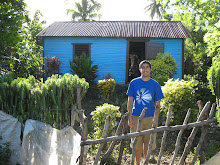
If I uploaded the picture right, it is me getting hit by one of those things at the time the picture is being taken.

viernes, 29 de febrero de 2008

tomorrow is february 29th

You know the saying, “like moths to a flame.”? Well, have you ever seen moths to a flame? I suppose its possible. But normally we just see moths to a light bulb, hopefully an energy-efficient one in these days of high gas prices. Here in the countryside, we use candles a lot. I’d say that we don’t have electricity after dark about 3 days a week. I’m pretty lucky though, since it will always come on by 10PM, and some of the other volunteers almost never have it at night. Anyway, when my host family and I sit around the table for dinner, or after dinner to talk, there is one light on in the house, which is the solitary candle in the middle of the table. Besides the gossip floating around the room and off the lips of my host mom, the house has its fair share of bugs floating around, too. Perhaps directed by our need for entertainment, they flock to the candle flame. The bugs zoom excitedly up to the flame, barely escape being burned, circle around again, and fly right into the candle. Usually it takes two or three time for the bugs to completely burn themselves to death. Sometimes the fall into the melted wax below, on fire, and get caught in the hot wax. The most fun comes when one wing has burned off, and the bug falls on the table. My host sister will stab the bug with a pencil, pick it up and hold it in the flame, until the thing is completely burned up. Such is campo entertainment.
Campo entertainment, unfortunately, also includes drinking. A fair amount of it as well. On any given day, especially as the day wears on, men of all ages gather in the street outside of the colmados (general store type things) and drink beer, rum and whiskey (the latter two straight from the bottle and warm… not especially pleasant). Pretty much the only jobs here are in agriculture. The entire place is essentially one big plantain farm. My host dad own the parcel behind his house, but he actually works it every day. I guess some of the other men in town give less importance to that and more to the more direct pleasure of the midafternoon buzz. I get offered alcohol pretty much every time I leave my house in the evening. It is hard to resist, especially a cold beer after another hot day under the Caribbean sun. So I usually take the beer. Warm whiskey, however, isn’t especially my thing, especially when half the population’s mouth has been on the bottle already. Así es la vida (such is life), they say here. I’m not a huge fan of this, either, since its pretty defeatist. I think that is why I haven’t been able to get too much done so far. Motivating people necessitates a cultural shift, which I didn’t get in training. Maybe I was sick that day.
Lets talk about me for a second. I haven’t written here in way too long. The first three months of being at my site is supposed to be taken up by a community diagnostic. Two weeks ago, I presented my findings in front of my colleagues and various bosses/trainers in a retreat center in the mountains that was an old home of Joaquin Balaguer, the dictator/”president” who came after Trujillo. I have both the powerpoint and word document if anyone is interested, just email me. Some pertinent findings: My little farming village (“campo”) has 110 houses and about 450 people. Almost half of the population is under 20. The majority of people have not made it out of primary school, though 30 percent of 20 year olds are in or have finished college. Most houses here are made of wood and have tin roofs, and the most popular occupation is farmer. I did interviews with 93 families. They told me the most important thing to them in the community was the church. Next was the school, and then electricity. They want me to develop the community so their children have a better future.
Now that I have finished my diagnostic, I now begin the phase of project implementation, which lasts until three months before I leave. I have some ideas of what I will do. I hope even just a couple of them succeed. This also signals the end of my class being the “newbies.” A new class just arrived, just as lost as we were six months ago. Welcome to the toughest job you’ll ever love.

martes, 8 de enero de 2008

feliz 2008

Feliz dos mil ocho, so they say here. Its been quite a ride these past few weeks, with many a fun event to share.

One of these things was go to a concert, to which they all referred as a fiesta. I now understand why. The artist, Zacarias Ferreira, a bachatero, has his music played pretty much all the time. The “Top 40” if you will, of this country is really like a “Top 5” and my amigo Zach is in the top three. So lets say late-90s Britney Spears, Jay-Z and Aerosmith, in one. This concert took place in a car wash. Here, car washes serve in the traditional sense during the day, and magically at night turn into raging discos, with crowds spilling out into the sud-filled parking lot, bumping and grinding against pickups and beaten-up four-doors. Zach decided to show up at 12:15 while the ticket said 10PM; this was no big surprise. The surprise was that the place was not full at all. I attribute this to the high ticket price – 500 pesos ($15 ish), which here is an exorbitant sum as an average monthly salary is, educated guess, around 4000 pesos. What I found fascinating is that the people there danced for those two hours on the dance floor to the DJ before Zach showed, then continued to dance while he played, and continued to the DJ when he left. There was no opener, curtain call, rows of seats. Just a dance floor, rum and speakers. I thought he was great, I think he should get more credit as a live performer.

Anyway, there were a couple more exciting things since I last wrote; namely, Christmas and New Years. Christmas here is something else. Pretty much the whole day I got trashed on rum with my host family’s massive extended family, and watched my host dad impale a 300 lb. pig with a 15 foot long, 4-in diameter branch, right from the anus through the mouth. Mmm. Lets start at the beginning. At around 8AM, I awoke to one of the worst noises known to man – the piercing, soul-shattering death squeals of a pig being slaughtered, preferably by hand. In this way, I knew Christmas had begun. Christmas here, by the way, means Dec 24, not the 25. The 25th is pretty unimportant. Being a Member of the Tribe, I know little about such things, but this I did find a bit odd. Thus awake, I went to the pig-killing site. When I arrived, my host dad, the death master, was pouring boiling water over the pig to more easily scrape off the pig’s mottled hair, which he did with the back of a machete. My host brother got the stuff host dad missed with a razor. This went on for quite awhile, until the pig was ready to be mounted on the spit above the fire pit, made in the backyard next to the coconut tree on which the goats are tethered. Host dad (named Aladino, but sadly lacking a magic carpet) then sliced open the gut, emptying the pig of its entrails. These were given to the women, who then dutifully washed and prepared this good stuff for later consumption. As I mentioned above, host dad, along with his brother, took this massive branch and shoved it clear through the pig, now consisting of just meat. This took a good deal of shoving, cursing (“carajo!” “Coño!” etc) and giggling from the visiting city cousins. My host dad has 10 siblings, so there were a lot of cousins. Two of the ones of my generation, 17 and 18, brought their infants, giving grandma great-grandkids.

Anyway, the pig was on the spit by 11, which signaled the commencement of the drinking. This meant purchasing a ridiculous amount of rum, to be drunk through the day. The pig sat on the spit, rotated by hand, for the rest of the day. In the afternoon, the skin getting nice and crispy, family members would walk by and tear off a piece of pig, chomping and grinning. I found this hysterical and disturbing, realized I was a bit tipsy, and decided to take a nice little rum nap before dinner. The rest of the day proved less eventful, save for a fight between a couple drunken uncles, which included such thrown projectiles as hard-boiled eggs, soggy vegetables from soup and boiled plantains. This, too, was hysterical and disturbing.

New Years was no less eventful, but certainly less culturally shocking. I went to Cabarete, a tourist town on the north coast, with about 60 other Peace Corps Volunteers. We spent the four days there pretending we were sophomores on spring break. I need not spell this out for anyone. Perhaps the highlight was the New Years’ midnight group skinny dip in the ocean, which apparently is illegal (who knew?). The police decided the best course of action was to take our clothes. Luckily, some more sober souls talked them out of permanently denuding the drunk Americans. The clothes got all mixed up in the process, however, and people ended up with all sorts of things that weren’t theirs. After about a half hour, I managed to find everything I wore to the beach, except for my boxers. These were apparently picked up and worn by a fellow volunteer’s boyfriend visiting from the states, who was so embarrassed that he avoided me the rest of the night once we figured it out. I swear, dude, we don’t do this all the time, and thanks for giving them back.

Until next time, si Dios quiere.

viernes, 21 de diciembre de 2007


Undoubtedly, the past month has been anything but quiet. Really, since I arrived in country, I have gone through an absurd number of both difficult and rewarding moments. Adjusting to my new live in my site, well outside of the proverbial box, has been difficult enough. Uncomfortable and exciting are two particularly good words to use here.


I arrive at my site November 13, and left on the 17th to spend a week in the capital for Thanksgiving. I returned to my site for less than two weeks, after which I went back to the capital the weekend of December 7-9 for the annual Artisan Fair, sponsored by the ministry of culture. In my village, there are four scattered unrelated families who make crafts from gourds called hig¸eros. They open up the gourds, which range in size from handball to cat torso, scoop out the nasty stuff inside, and make intricate carving designs on the outside. Such products they make are cups, bowls, canteens, ornaments, centerpieces, guiras, and the most popular item, maracas. After trudging down my dirt/mud road in the pouring rain to the highway with five massive rice sacks full of hig¸eros, my artisans and I sat in the rain on the highway for a half hour to catch the guagua to the capital. There, for three days, artisans from all over the country sold their coconut earrings, scented candles, and soapstone carvings to tourists. As a Volunteer, I served as translator. Example:
Overweight German tourist in heavily accented English: How mooch iz thiz?
Artisan lacking many teeth: Que?
German: How mooch?
Artisan: Oh, cien pesos.
German: Vat? Ten?
Then I graciously step in and mention that the really cien is ten. I was impressed by this fair if only for the quality of the products, as they were much better than anything found in a beachside tourist trap gift shop.


Over this weekend, I was able to explore Santo Domingo a little bit. This included the discovery of a falafel restaurant downtown, which raised the value of the city for me quite a bit. In addition, I stayed at a hostel that all the Volunteers stay at whenever he or shi is in the city, turning the hostel into some kind of massive frat house. This was fun.
I came back to my site Sunday evening, and spent Monday quietly with my host family, staying inside because of the rain. Unofficially, the rainy season is the summer, but it has rained nearly every day since I arrived in country. Watching the news Monday afternoon, I noticed a bit about a "tormenta" coming the next day. It being December and all, I didn’t think too much of it, but soon after I received a text message from Peace Corps informing me that Tropical Storm Olga was on its way. The next day, Peace Corps initiated Consolidation, which meant that all volunteers had to leave their sites and head to a safe house (ie, hotel) in the major city nearby. Unsurprisingly, this also created a sort of college dorm atmosphere. Kept safe from the dangerous storm outside, we were able to take a three-day vacation inside, complete with three nice meals, wireless internet and lets say, more fun activities.


Finally, I returned home last Thursday to see my dirt road turned into mud and some downed trees, but thankfully no serious damage. I was able to settle down and relax with my host family Thursday evening, eat some boiled platanos, and watch a couple melodramatic Mexican telenovelas. However, just as Julia was about to inform Miguel that the baby wasn’t his but Enrique’s instead, a low rumble filled the house, which began a slow roll and then shifted violently. Earthquake. My host family didn’t flinch. Nothing fell, but it freaked me out.
So, in my first three months in country, I have survived three host families, two tropical storms, and one each of earthquake, parasite, and gripe. I can only imagine what the next twenty-four months have in store for me.


this picture is of the people i spent the most time with at my site. this is what we do for fun in the evenings.

miércoles, 12 de diciembre de 2007

Peace Corps: A puzzle

One year ago, I was a first semester senior, worrying about finals and papers and the like, as well as trying to forget that college was almost over; I refused to participate in the obsessive culture over what to do after it was all going to be over when the following May came around too quickly. I was about to submit my Peace Corps application. Applying to Peace Corps oddly mirrored my college process. Each times, I applied first to both Georgetown and Peace Corps, and while I submitted other applications, I did so with less energy and conviction, convinced as I was that I would get in. And although both choices were those of a different path than the vast majority of my peers (Georgetown is Catholic and I am from Jewville; Peace Corps drops its Volunteers in the middle of nowhere with nothing but luck, some phone numbers and a few thousand dollars a year), and many, if not most, thought these choices didn’t make sense or were simply crazy, I knew they would be right for me.
Over six months ago, I graduate from college. I walked across that stage a proud holder of a BSFS, but still without a job. Peace Corps, as any bureaucratic arm of the US government and thus notoriously slow, had yet to inform me of my invitation, or give any indication of wanting to communicate with me. A tearful goodbye in DC, and I was an unemployed college graduate. Still, I waited. It would come, I was sure.
Three months ago, I got on a plane in Washington, DC, my home over the last four years, and flew to a land geographically quite close to the US but in other ways far, far away. We were warned in staging: there is a lot to know, and you will feel lost. There will be many, many difficult times, but also the most rewarding ones of your lives. For two years. Pa’ que sepas.
So, I write this today. I have lived in my little farming village in the hot central valley of the Dominican Republic for two long, long weeks. I have met some truly amazing people, American and Dominican, and have met with some truly frustrating moments. Almost ten percent of my training group has left the Peace Corps. Now, I am more than just physically separated from my life in the US, but I do have my laptop here to keep me sane. I know that am in the right place, although I haven’t had a solid poop in almost four weeks. Two years is a long time for us – who knows where we will be in November of 2009? I know: I will be finishing up here in my little farming village and returning to the States, having achieved a certain measure of success as a development worker in my small corner of the world.

domingo, 18 de noviembre de 2007


this is me with bunny pelt on my bunny farm. the other is the goodbye rave party.
These couple weeks have been pretty boring. I finished CBT with a rave party, spent a day at the US Embassy, got locked out of my house, received a cell phone (a call would be really sweet), and lastly got my site placement. The place where I will be living for two years is… [cue favorite dramatic movie theme music] well, I’m not supposed to say exactly where it is for security purposes. If you really want to know, email me. I spent most of this week visiting, however, so I can say it’s a great little pueblo in the north-central part of the country with about 1000 people. I have electricity (sometimes) but there is no water in the tap, so it magically appears in a large bucket in the bathroom every time it gets low. This is terribly confusing as the bucket looks like a big trash can, which is where you put the used toilet paper, since you can’t throw it down the toilet like at home. This clogs the already mostly water-less pipes. Messy indeed. Anyway, it seems that this bucket-water originates from the sky and is transferred through drops and a bigger bucket placed outside under the gutter, but I wonder what they do when it doesn’t rain. Besides the water, my host family is great, the town is only a couple minutes by moto from bigger towns with internet cafes and other volunteers, and only 2 hours from the capital. My host dad is a platano/ yuca (potato-like tuber) / batata (sweet potato-like tuber) farmer. Finally, my primary project is working with a youth group, their upstart bunny farm microbusiness, and other family/microbusiness finance. More on bunnies: have 60 of them in my backyard. They come in many different colors. Adults weigh 4ish pounds, 2.25 meat. Saturday I watched my host brother kill, skin, and disembowel a rabbit (white with black spots and big brown eyes), which we ate for lunch (not kosher, but delicious nevertheless. I’m thinking we make an addendum to let them in).
I’m back in the capital now, swear in on Wednesday, celebrate Thanksgiving Thursday, and return to my site for two (2) (!) years this weekend. This is where you make your plans to visit. Bring mosquito repellent.
The picture is the goodbye rave in training.