sábado, 22 de noviembre de 2008


This time four years ago, I was on the front lines of the presidential election. For the months leading up to the elction, I was working with various organizations on registration and GOTV efforts – phone-banking, canvassing, whatever. Election night, I was in a hotel ballroom in Orlando, watching the returns come in, with hundreds of other election volunteers. By the time we had to board our plane back to Washington, DC at 2AM, we knew it was over. Our hard work, our valiant efforts, just weren’t enough. We went back to our normal lives as students, chafing under an administration that we were unable to change.

This time around, it was a little different. Four years later, I am in a different place. No longer a student, probably less idealistic, and certainly in no position to do any campaigning, I watched from afar as well as I could. I asked for email updates from friends and I checked the news whenever I was able to use the Internet.

Watching CNN from afar is fascinating. I happened to be at the Peace Corps office (where there is cable) when Sarah Palin was introduced to the world. The other Volunteers and I were intrigued. Who was this mysterious, folksy woman from Alaska? The only thing CNN seemed to be concerned with was that she has a pregnant teenage daughter. All news, all the time. Anyway, I was back at the office a week later and they were still talking about her. By then, I had found out a little about her. Could Americans be that dim? Thankfully, it looks like they came around.

What I found most interesting is that Dominicans have taken an interest in the election, even in my isolated village. I have not met one Republican Dominican. Every single one would vote for Obama if they had the chance. Maybe its because although they won’t admit it, they all secretly know that they’re actually black, and this is their outlet in acknowledging this fact. Or perhaps they are genuinely concerned for the state of the world (I am often told that the money spent on the Iraq war could be better spent otherwise, like helping the poor. I couldn’t have said it better). Dominicans would not caught dead calling themselves black (on the national identity card, there is a space for skin color. Every single one I have seen says “indio,” which in Dominican parlance, covers many shades of brown), so here was their chance. They readily called Obama black, or even “prieto” (really black), but with a tone of respect.

For election night this year, a few of us got together at a hostel with cable in a nearby city. We watched CNN, as I did four years ago, anxious but hopeful. This time, the room didn’t fall silent but erupted in cheers, and the only tears to be found were those of joy. All of the local news programs the next morning devoted thorough coverage to the election of the new presidente Americano negro.

Just as good was when I returned home. I have received congratulations from at least ten different families. When I walked into my host family’s house, my host mom’s face erupted into a huge smile and she hugged me, telling me that she and her family were so happy and very proud, and looking for a better next four years. The interest and reaction of my neighbors made not being in the States at least a little bit better. I, too, am happy and proud once again at what my country can produce.

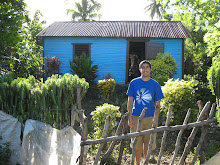
The picture should be of my youth winning the business plan competition I wrote about awhile back, he is the one in the middle holding the small certificate.

Un Ano


aA year in the Peace Corps. One year ago, I arrived at my site for my first visit, although I did not swear in as a Volunteer until the next week. We say that the year has passed quickly, or at least it feels like it. But the things I have seen and accomplished in the past year are many, so I argue that this year was, in fact, very long. I hope that the next year is even longer, as I have even more to see, accomplish, and then conclude before I leave here in November, 2009.

It being around Thanksgiving time, let me step back and give thanks for some of what I have here. When I was home in August, it was nice not sweating waking up or having to battle tarantulas, but there was also something missing. I couldn’t go next door, be offered fresh papaya juice and play dominos or talk about life. Children didn’t wander barefoot into my house and they didn’t scream my name when I walked past. Although my mother might tell me differently, I’m just not as special in America as I am here. My neighbors truly care for me and for my work (most, anyway). They see me as an asset, and they are happy that I live and work with them. We enjoy the most basic aspects of life together – a brilliant moon, a smiling child, freshly cut sugarcane. Sure, they complain, and often with good right, as plenty is lacking here. They, however, also know how to value what they have, which I find inspiring. I have certainly learned just as much from them, if not more, as they have from me.

Another reason I am glad I am here is not having to worry about all this financial mess going on back home. Since I have a net worth of almost nothing, it hasn’t really affected me that much. This net worth isn’t growing very quickly with the money I receive here, although I just got a raise – I now earn five figures (in pesos). Of course, inflation here has recently gone up, so this new money is disappearing fast. At home in my campo (village), I spend almost nothing – rent is $12 (yes, dollars) and I pay my former host mom $30 a month to feed me lunch. Dinner last night was a 45-cent avocado with two pieces of ten cent bread. My neighbor makes ice cream in little plastic bags for eight cents, so I had a couple of those, too. The electricity here is unreliable at best, so the end product tends to resemble half-frozen sugared juice. Nevertheless, still delicious.

So, a year to go in the Peace Corps. Wish me luck. Sending me things would be nice, too.

martes, 23 de septiembre de 2008

It's Raining.

Whoa, hurricanes. Americans don’t think too much about hurricanes, unless we life around the Gulf of Mexico. For the rest of us, it is a bunch of funny sounding named (Olga? Wilma?) swirling colors far out in the ocean. Last year, the DR got pounded first by Noel in October, when it rained for seven straight days, and then by Olga in December, when a dam broke, resulting in numerous deaths and extensive property damage. Recently, we have taken hits from four storms in a row: Fay, Gustav, Hannah, and Ike. We were pretty lucky here, though our neighbors Haiti, Cuba, and the Bahamas didn’t catch a break.
Anyway, back to me. Back in August, when I was in the States, Fay moved past the DR. Then, the morning I got here, Peace Corps notified us about Gustav. We were put under “standfast,” which means that we are not allowed to leave whatever our current location is. The storm moved to our south, and did some pretty significant damage down there. Since I live up in the north, all we received was a little rain.
The next weekend, I went to Celebrando el Cibao, which I wrote about earlier, and then went to the capital on Monday for a meeting. As I was about to leave on Wednesday, we were informed that Hannah was coming, and so we were put under “standfast” again. Standfast in the capital isn’t that bad – we receive per diem, and get luxuries like the internet and AC that don’t happen too often (ie ever) where we live. Hannah was a little difficult – for a few days, instead of moving west it turned south and almost hit Haiti, before moving back north and west again. During Hannah, we watched Ike form – a massive Category 4 storm churning out in the Atlantic. Peace Corps was in crisis mode. At the end of Hannah, we were allowed to leave the capital, but the next day for Ike the Volunteers in my region were “consolidated.” This means that we all get together at a central, secure location. This location turned out to be a really nice hotel with a pool, tennis and basketball courts, a casino, great food, and most importantly, really sturdy walls. We were left there for four days. Things like these pose problems for us. We all have our work at home – youth meetings, building projects, English classes – that we obviously can’t attend to while we are at the hotel. We worry about our communities, and have trouble getting in touch. Sure, consolidation is great, but we have our lives we have to take care of outside of fun hotel jaunts. Our neighbors cannot figure out why we leave. If our neighbors stay, why don’t we? This is the hardest question to answer. We have to, we say. But we also are Americans, cared for by our government, and we can afford it. That’s just not they way it is for our neighbors.

When I got back, my neighbor had made a dessert called “toto de monja.” Ten points for someone who knows what this means, and then they get some.

Hey, look, diversity in the DR

Four days after I returned to the DR, I participated in a weekend conference of volunteers from the northern valley region of the country, called the Cibao. (Thank you to those who supported this conference from the States. All of us here are very appreciative.) The conference, focusing on diversity and aptly named Celebrando Cibao, brought together two youth from each volunteer’s community (there were about 25 of us) for three days of speakers, discussions, and interactive programs. You can imagine that when I first heard about the Celebrando conference, I was pretty pumped, as I dedicated a fair amount of time at college to such activities. This is the Peace Corps’ version of YLEAD. It didn’t turn out quite the same, but it was similar in spirit, which is the important part. Sure, there were some slip-ups and last-minute cancellations, but we got the message across, more or less.
Celebrando Cibao is an exceptional Peace Corps program – it is programmed and executed entirely by Volunteers, who must also obtain all the funding. This also means we are free to discuss the topics we deem important. A conference like this is also a chance for campo youth to get out of their little towns for a weekend and meet some new friends. Remember any kind of trip you went on as a kid, and multiply that by a high number. Most of the participants have never left their small towns except to go to school or visit relatives in the capital. The students that came with me have never been to the beach, less than three hours away by public transportation.
Planning a conference always makes doubters out of the organizers, but I know that the participants had an amazing time. The Volunteers led a range of informative discussions, including Dominican-Haitian relations, sexuality, religion, ability, and domestic geographical differences. My personal highlight, perhaps unsurprisingly, was an activity we coordinated called Archie Bunker’s Neighborhood, in which participants are unwittingly thrown into a class- and privilege-based social system and only realize this halfway through the activity. My goal was for the students to realize that no, not everyone is treated the same, and this happens in real life. They were able to extrapolate their experience to daily life in the DR. The youth, living in poor, isolated communities, were able to get the message. While some other issues they chose to ignore or to give hollow lip service (sexuality, racism), they understood class. It’s the small victories. Plus, they got to run around in the grass, a rarity here, and watch some of us Volunteers perform a uniquely choreographed dance that we came up with ourselves. Overall, a big success.

The pictures are of all of the participants, and then me and the youth from my community.

jueves, 18 de septiembre de 2008

Los EEUU


America!
I went home for a couple weeks last month. Yeah, America was still there. I guess I had forgotten some of the things I like about it. Sure, its fun here. But flat-screen hi-def plasma TVs are fun too. So much detail. I went back to the grocery store and stood there, mouth open. There was so much stuff. Thousands of kinds of cheese. I wonder sometimes if it is all necessary. But then I see real Heinz ketchup, not the low-quality overly sweet stuff they call “catsoo.” I think the food is what really got me. There is so much good stuff here. Mexican, Thai, Chinese, its all amazing. Also, bagels. Bagels and lox. Nothing better. The visit went by too quickly, but I was able to get in a visit to Boston for my cousin’s wedding (mazel tov!), be around to celebrate my grandmother’s 80th birthday, and run around Washington, DC for a few days to finally see my name on the wall at the Tombs.
I had heard from other volunteers that coming back to a volunteer’s life was a difficult adjustment. After being in the States, with all of life’s luxuries, and even those simple things (electricity all the time?), it is hard to get back into things. At this one-year mark, which a few of us celebrated by going the beach and then me subsequently getting a double ear infection, we have to reassess what it is exactly that we are doing here. Are we accomplishing our goals, personally or work-related? Are we really that integrated in our communities? What are we actually doing here? Let’s not get started on sustainability. Right now we are just trying to accomplish something for ourselves, let alone the progress reports we are required to send in to prove that Peace Corps still deserves to receive federal funding. It does, of course, but not because we are saving the world. The stove we build that uses less wood, thus helping the environment, and has a chimney, so women don’t have to breathe in smoke five hours a day, is just as or more useful than a business presentation that will go right over the heads of its participants.
I got back to my site, then, expecting the worst, hoping for the best, and landing somewhere in the middle. Really, I guess, the best happened. It took me about a day, but I got right back into my routine. I remembered how much I appreciate what I do and what my community means to me. It definitely helped that my neighbors were thrilled to see me again and I got some free food as a welcome back gift. They know already the way to my heart. Hopefully a good omen for the rest of my service.

This is a beach relatively close to me (read: on the same island as I am)

martes, 12 de agosto de 2008

The daily trials of a Volunteer

The Peace Corps here in the DR publishes a magazine three times a year, called the Gringo Grita ("grita" means something like scream or yell). In the last edition, which had a man-eating mango on the cover and featured pieces about relations between Haiti and the DR and among Peace Corps Volunteers and locals, I wrote a very personal piece about some medical difficulties and how I overcame them. Enjoy.

“Squish, squish,” said my stormy abdomen, churning gloriously. I winced.
“Crunch, whoosh,” it retorted. I winced again, and made a sad face.
“Squirt.” Oops.
That day’s conversation with my roiling innards was not any different than any other day for the three months following Thanksgiving. Through the smashing waves of New Years and project partner presentations of IST, I had been in constant state of disagreement with my digestive system. Perhaps, rather, it was in disagreement with me. Whatever the case, we were not on good terms. This problemita I had just would not go away. I was put on PCDR Medical cure-all, Gabbroral, twice, but to no avail. I consigned myself to twenty-seven months of internecine turmoil.
I realized it didn’t have to be like that. I could live an ordinary life, eating all the platano sancocha’o I could ever want. One quick call to Lisette gave me the key to potential normalcy. The Stool Sample. This was no small step. It had been offered to me before, but I was hesitant. Do my business in a cup? No thanks. I had heard from those who have had the pleasure that it was uncomfortable. I came to realize, however, that the ends justified the means. I would go through with the unpleasantries of The Stool Sample, as they were less of those than living with an internal Mount Vesuvius.
So, after I listened to my heart, I took the Caribe Tours – Arctic Express bus down to the capital for the poop procedure.
“Here you go,” Boriana said cheerily, handing over what looked to me like a cheap coffee cup in a wax-paper bag. “They don’t need that much, but try to get different bits in there for more complete test results. Also, the van to the clinic leaves the office at 7:30. If you miss that, you’ll have to take it there yourself.”
The luxe digs of Volunteers in Santo Domingo aren’t exactly the most comfortable for those with medical issues, which is probably why those poor kids get the one nice room, the Dengue Suite. Nevertheless, it being the capital, evening activities took their toll. I woke up well after the early morning pick-up. I would have to bring the sample to Clinica Abreu myself.
I walked out of room 14 and steeled myself. Wandering down the hall, I sipped a miniature plastic cup of water from the cooler, watched a bit of the mid-morning telenovela and the returned to the room. I was ready.
I removed the paper coffee cup from its protective bag and slipped into the bathroom, feeling at once terrified and strangely pleased. I positioned myself in a sort of half-lean over the toilet, and awkwardly placed the cup underneath me. I tried to heed the good words of Boriana, but it wasn’t that easy. It never is. The cup was situated slightly incorrectly – I missed and might have got my hand. Within seconds and way too soon, the cup overflowed. Splatter ensued. But I had done it. I was triumphant.
My euphoria fell, after thorough hand washing, when I realized I now had to traverse downtown Santo Domingo with a cup of my own poop in my hand. I needed help, and enlisted a fellow Volunteer to take this journey with me. By the time we had crossed Bolivar, she was walking ten feet behind me. I asked her why she was so far away. The smell, she told me. I guess I had not noticed it, or not wanted to. The wax-paper bag was not a terribly good protective barrier for the outside world from my malodorous offerings. Being of good heart, my travel companion stayed with me, even as I offended the general population with my wax-paper bag (Thanks, Joanna!).
We finally reached the clinic. I took a number, sat down, and put the treasure bag under my chair. According to the number display, I knew I was going to have to wait awhile. After settling in, I realized that of all the empty seats in the nearly full waiting room, the majority was right next to me. New patients seemed to strategically place themselves as far away from me as possible, putting on sour faces and suppressing giggles. My audibly gurgling intestines probably gave me away as the source of their olfactory discomfort, overcoming even my coy smile.
My number was finally called and the clerk beckoned me into the analysis room. I had heard that the sadistic nurses make patients scoop their own poop into the machines, but thankfully these nurses had eaten their viveres that morning and were fairly cheery. I did, however, get a killer look from the nurse who had the misfortune of opening my special container. I grinned. The pleasure was all mine.
I arrived back at site the next day. The call from the medical office reported that my test results had come back negative. As much as I thought I had very close special friends living with me, the tests found no amoeba, parasite or giardia. By then, however, it didn’t matter. I was feeling better already. I had pooped in a cup, and I was cured.

miércoles, 30 de julio de 2008

thoughts on our work


So I am going to try to write here more often. This means I’m writing now, and has no influence on how often I may or may not write in the future. This entry might be the last one ever. Likely not true, but you can never tell. Among the volunteers here in la RD, there are 6 areas of work, or sectors: Youth, Health, Education (Special Ed and IT), Environment, Water and Business. Generally, business volunteers like myself (yes, ironic that I was assigned to this sector, but where else was I supposed to go? Health?) are placed in campos, or small villages, but nothing especially isolated, since we are usually assigned an organization or institution with which to work. By nature, we can’t live in cut off villages with no resources, because they also would lack organizations. Although my campo seems pretty out there (it is one of the poorest in the province, but the province itself is fairly rich), it is only a seven-minute motorcycle ride to the nearest town, fifteen minutes to the provincial capital, and a two-hour AC bus ride to Santo Domingo. Last weekend, I visited a few Water volunteer friends. The task of the water volunteer is daunting – find a water source and then create a gravity-fed system of tubes to bring running water down to the particular village in which they live. Unsurprisingly, these are small, isolated mountain villages with tiny populations. Most lack electricity as well as water, in addition to other services such as transportation infrastructure, local schools, and cell phone service. The volunteers must raise all of the money through grants and other means (Peace Corps itself does not supply funding), and interestingly are often unable to find money from the local or national government. Perhaps most daunting of all is organizing local Dominicans as workers on the project. [Any project we do in our sites must include local participation. Our understanding of development begins with a foundation of willing local populations. To arrive at a site, implement projects without any local input and leave is not only inefficient and unproductive, but also insulting to local customs, values, and intelligence. That being said, we often spend time with local leaders in discourse about the value of said projects that we believe are of importance.] In these villages where water volunteers live, the majority of the population is unemployed, getting by on only a subsistence level. Thus organized, daily work based on time-specific goals can be somewhat foreign, and compound construction difficulties. Nevertheless, obtaining running water (often potable, because the sources are from mountaintop springs or streams) in these villages can vastly improve quality of life. Visiting this kind of site was like visiting a different country, just like it is every time I go to the capital. The disconnect between the capital and where I live is enormous, and is even more so with these places. Interestingly, it looks like I might be turning into something of a water volunteer, if only helping coordinate the digging of a few wells around here. The tap water here is dirty and unreliable, so many people get it from the polluted river, catch it from the roof when it rains, or pay for it to be delivered. I am hoping that with these wells, people, mostly women, will spend less time and money looking for water for their families. Incidentally, I have learned to shower with about 2/3 of a gallon of water. Next week, I will be heading home for a nice-sized vacation. You may find me sitting on my parents’ couch with the remote, marveling at how pretty the picture is on the television and astounded at how many channels there are. Until next time, whenever that is. Si Dios quiere.
Also including a picture, because they look nice on here. This is me at another volunteer's site hiking up a river.